This post was originally published at the LinkedIn Newsletter ‘Atelier of Life Notes’
I’m not the type to want or to need to see a silver lining in every experience.
Of course, it’s great to learn through experiences, whether they are amazing, traumatic, good or bad, comfortable or uncomfortable. But I am not driven by a need to ‘see the positive’ in everything.
That said, I have been thinking lately, inspired by a dialogue with an old friend, to meditate a bit on the role of rejection in my life experience, my work, my accomplishments, and even my self-worth.
It’s common to share achievements on LinkedIn, a professional networking platform.
It’s a great feeling to share about successful projects, milestones, and professional achievements.
It feels good to ‘be seen’ and congratulated for ones achievements and professional activities. Naturally, we like to celebrate accomplishments.
It’s generally probably not as fun or endorphin-producing to talk about failure and rejection.
Every now and then, I see some great content about people reflecting on ‘failure’ and how it should be more comfortable and familiar to speak about it, but as we all know, it’s not.
There are, of course, people who don’t shy away from talking about barriers or even what are experienced as professional failures, but it’s not as common, including for myself.
And it’s no surprise. The value of sharing about a published article, for example, is also being able to share the work with others to read. Why would we post about rejections?
However, I recently reflected on how I want to get more comfortable with the discomfort of talking about what doesn’t work in my process or how my own development is influenced by difficult moments or diverse and specific professional pressures.

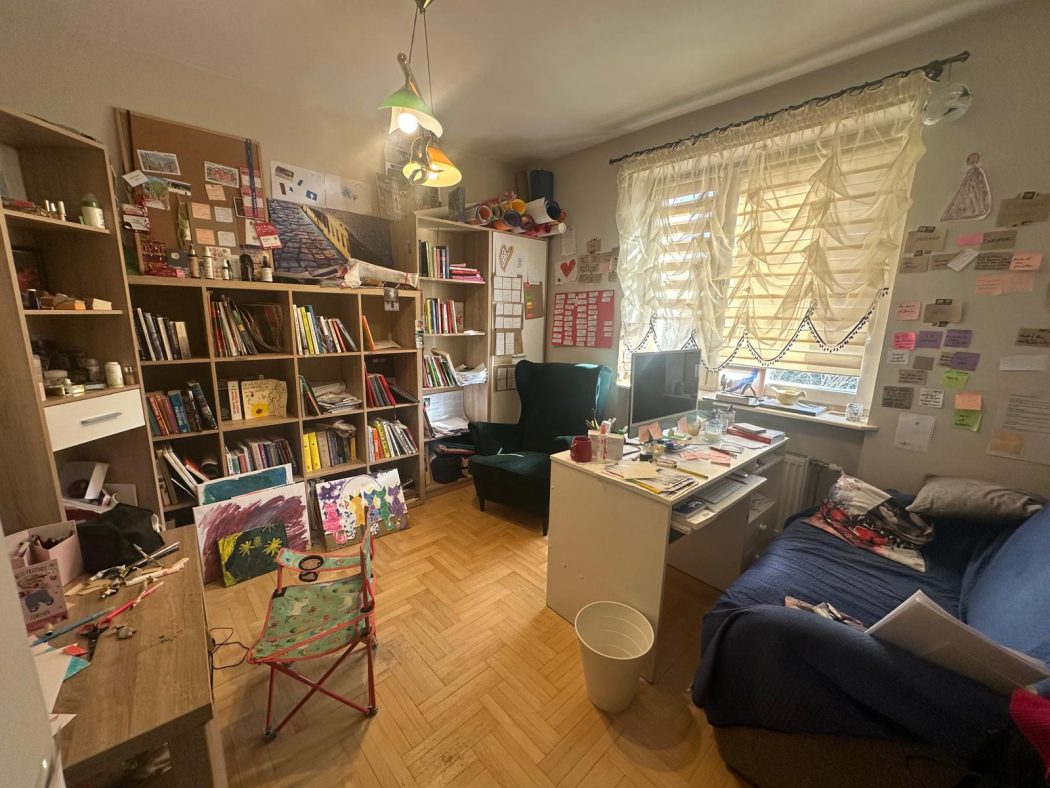
Yesterday in my home office, which I would say is a pretty decent spatial reflection of what my mind feels like often
Yesterday, as I worked on revising a paper, I reflected on my own adjustment to the research article review process over the past year.
Over the course of a little more than a year, I’ve had research articles published, research articles rejected, and research articles with demands for moderate to radical revision.
One of my key psychological barriers, I realized at some point, was my impatience.
I’m almost 50 and have lived a life full of self-reflection. Of course, I’ve known about my impatience for decades.
People are full of contradictions, and one of mine is that I can also have unlimited patience- for example, in working with young children.
I also clearly am not too terribly hindered by impatience, or I would never have entered research in the first place.
If I were crippled by impatience, I would never have had the curiosity and patience to do the ongoing literature reviews, conduct the fieldwork, write and produce the research in the first place.
But if I am being honest with myself, one of my biggest challenges in the revision process is exactly that- the impatience.
But yesterday, as I enjoyed a relaxed and quietly busy Sunday in my home office, working on a revision of a paper, I reflected on how much I had developed in this regard in just the past year. Every opportunity to revise has been an opportunity to confront my impatience, sit down with it, and allow the tension of that mood to be smoothed out as I relax into the revision work that ultimately should help to produce a stronger, more compelling, and clearer read.
I’ve gone through this process multiple times now in the past year, and interestingly, I find that as I allow the impatience to be acknowledged but also challenged, the mood changes, and revision has sometimes been a truly cathartic and exciting process.
What is your biggest internal/psychological barrier? Stacking your schedule too high? Lack of motivation? Procrastination? Lack of confidence? Unwillingness to address personal flaws?
I’m excited to get more comfortable reflecting on moments of so-called ‘failure’, rejection, and characteristics that feel like ‘flaws’. Why? Not to celebrate them. Not to say ‘everything is acceptable’- but to understand them better and the roots of their existence in my personal make-up.
I decided to start reframing what can be perceived as ‘flaws’ as ‘special needs characteristics’. I intend to get even more comfortable with them and give them the extra, thoughtful support they need.
Atelier of Life Notes is a newsletter began in January 2026 by photographer, writer, advocate, and scholar Annika Lundkvist to share notes and thoughts on work, positionality, process, and craft.